


You search your own service in Amarillo, and there you are, sitting at number two on Google. Nice. Except that the AI Overview at the top of the page already answered the searcher’s question, recommended your competitors by name, and never mentioned you once. By the time anyone scrolls down to your link, the decision is half made.
Ranking on page one used to be the finish line. In 2026, it is not even the same race.
Here is the data that should change how you think about visibility. Ahrefs analyzed 863,000 keywords and 4 million AI Overview links and found that only 38% of cited pages also rank in Google’s top 10 for that query. Seven months earlier, that number was 76%. The link between ranking high and getting quoted by AI has been cut almost in half in under a year.
Your page-one ranking no longer guarantees you a seat at the table where the answer is written.
AI Overview does not grab the top ten blue links and paste them in. It takes the searcher’s question, breaks it into smaller related questions, and pulls sentences from across the web to assemble one answer. Then it cites the sources that gave it the cleanest, most usable pieces.
So the real question is not “Does my page rank?” It is “Can AI lift a clear answer straight off my page?” Those are very different things.
If a visitor asks, “How much does a metal roof cost in Amarillo?” and your page opens with four paragraphs of company history before the price appears, the system cannot extract a clean answer. It moves on to a page that gets to the point.
If your business is barely mentioned anywhere outside your own website, your entity signals are weak. AI tends to cite sources it sees referenced and trusted across many places, not just on your homepage.
Ranking for a broad topic is not the same as answering a specific question. A general “roofing services” page can rank while a competitor’s focused page on “metal roof cost” wins the citation.
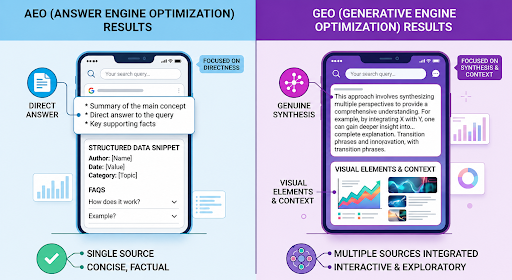
These two terms get thrown around together, but they solve different problems.
Local businesses need both working together. That combined approach is what modern AI SEO actually means in practice.
Put the direct response in the first line or two of the relevant section, then explain underneath.
One strong hero page is not enough. Cover the full cluster of questions a customer asks before buying, not just your main keyword.
Keep your name, address, and phone number consistent everywhere, earn reviews, add the right schema markup, and get mentioned on local and industry sites.
Ranking still matters, but it is only half the picture now. The businesses that win are the ones AI can read, trust, and quote.
In a city this size, you are not fighting a thousand national brands. You are competing with a handful of local players, and AI Overview is now the thing summarizing those local options before anyone clicks. If it consistently names your competitors and skips you, you are losing customers you never even saw search.
Let Couture Marketing Group help your Amarillo business show up in both search rankings and AI answers. Contact us today or call (806) 336-0532.
Can my website rank on Google but not show up in AI Overview?
Yes, and it is increasingly common. Recent analysis found that fewer than 4 in 10 AI Overview citations come from pages ranking in Google’s top 10. AI assembles answers from passages across the web, so a top ranking no longer guarantees a mention.
What is the difference between SEO and answer engine optimization?
Traditional SEO works to rank your page for a keyword. Answer engine optimization Amarillo focuses on formatting a clear, self-contained answer that AI can lift directly, usually near the top of the relevant section and backed by a concrete fact.
How do I get my business cited in AI Overviews?
Lead each section with a direct answer, cover the full set of questions customers ask rather than one broad page, keep your business details consistent across the web, and earn mentions and reviews on local and industry sites so AI sees you as a trusted source.
Does generative engine optimization replace traditional SEO?
No. Generative engine optimization, Amarillo builds on SEO rather than replacing it. Traditional search still drives most website traffic, and AI engines rely heavily on well-structured, authoritative pages, so the strongest results come from combining both.



Comments are closed